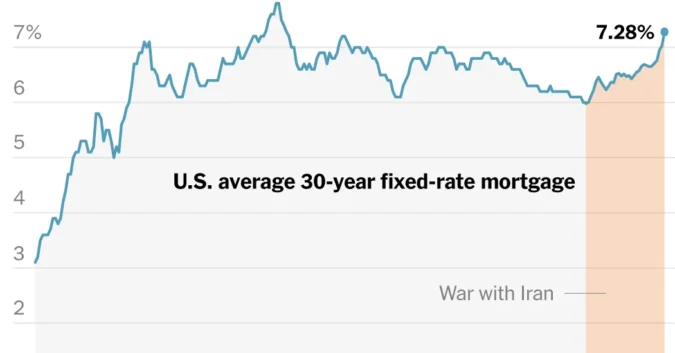
WASHINGTON, DC — Mortgage borrowing costs climbed again this week, pushing the average 30-year fixed-rate home loan to 7.28 percent, according to Freddie Mac. That was up from 7.03 percent last week and marked the highest level since November 2023.
The move deepened an already difficult affordability environment for buyers who are facing high home prices and monthly payments that keep stretching household budgets. As rates move up, some shoppers are starting to look at loans that can offer a lower initial payment, even if they carry more risk later.
Why the latest jump matters for home buyers
The 30-year fixed mortgage is the most common home loan in the United States, so changes in that rate ripple through the housing market. Freddie Mac’s weekly reading showed a sharp enough increase to make borrowing more expensive for new buyers and for anyone refinancing.
The average rate is also well above where it stood a year ago, when it was 6.34 percent. That gap can translate into a noticeably larger monthly payment, especially on higher-priced homes or larger loan balances. For many households, that difference is enough to change the kind of home they can afford or whether they can buy at all.
Rates have been moving up since late February
Mortgage rates had dipped below 6 percent at the end of February, but they began climbing again after the United States and Israel attacked Iran on Feb. 28. The conflict helped drive up energy costs, which in turn fueled fears that inflation could stay sticky.
Those worries moved quickly into bond markets. Investors pushed up the yield on the 10-year Treasury note, which reached its highest level since 2002 on Thursday. Because mortgage rates often track the 10-year Treasury, the increase fed directly into higher home loan costs.
Treasury yields are helping set the tone for mortgages
The 10-year Treasury yield acts as a benchmark for a wide range of consumer and corporate borrowing, including mortgages. When that yield rises fast, lenders generally raise home loan rates to keep pace with market conditions.
This week’s jump in mortgage rates was the largest since October 2022, underscoring how quickly borrowing costs can change when investors grow more cautious. The change reflects not only housing-market conditions but also broader concerns about inflation, energy prices and the direction of financial markets.
More shoppers are weighing adjustable-rate mortgages
With fixed rates so high, more buyers are turning to adjustable-rate mortgages, or ARMs, to lower the cost of getting into a home. Real estate experts say these loans can start out significantly cheaper than a traditional fixed-rate mortgage, sometimes by as much as a full percentage point.
That difference can save borrowers thousands of dollars a year, at least at first. But the tradeoff is clear: an ARM can reset later, and if rates continue to rise, monthly payments can increase when the loan adjusts. For buyers trying to bridge today’s affordability gap, that gamble is becoming more tempting.
Borrowers are choosing between lower payments now and more risk later
For households that are already being squeezed by higher prices and borrowing costs, the appeal of an ARM is immediate. A smaller initial payment can make the difference between qualifying for a loan or staying on the sidelines.
Still, the risk is built into the product. If market rates remain elevated or climb further, borrowers could face a higher bill once the loan resets. That uncertainty is why the recent rise in rates is not just a number for economists watching bond markets; it is shaping real choices for home buyers trying to plan around monthly expenses.
What the market signals mean heading into the summer
The latest Freddie Mac reading suggests the housing market is entering another stretch of pressure after a brief spring decline in rates. Buyers who had hoped for cheaper financing may now have to reconsider timing, loan type or the size of the home they pursue.
For sellers, higher rates can also narrow the pool of eligible buyers and slow demand. For lenders and agents, the sudden shift is a reminder that mortgage costs can move quickly when global events and market expectations change. The current level leaves many buyers with fewer easy options and more difficult decisions.
More on what homes, rents and new builds are doing near you, on RHS Commoner.
