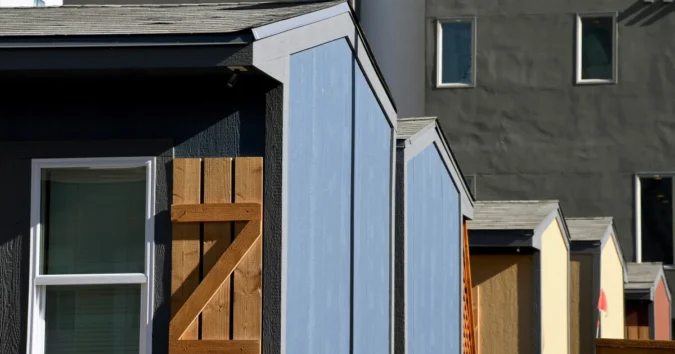
AUSTIN, TX — People living on the lowest incomes are running into a hard reality across the U.S.: apartments labeled affordable are often out of reach, even when they sit empty. In Austin, a man in a homeless shelter says even a $450-a-month tiny home with no running water would strain his budget. At the same time, thousands of affordable units in the city are vacant.
The mismatch is showing up in several cities, where rents for some subsidized apartments are rising close to market levels. That leaves the poorest renters unable to qualify for, or afford, homes that are technically set aside for lower-income households. The result is a growing gap between housing supply and the people it is meant to serve.
A shelter resident in Austin illustrates the gap between rent and income
Mathew Davis, 49, lives in a homeless shelter in Austin and survives on a few hundred dollars a month from donating blood plasma. He said he would like an apartment of his own, but the math simply does not work for him. Even the cheapest options he can find are far beyond what he can reliably pay.
Davis said he has spent years trying to move out of homelessness, including a stretch of about a year living in his car before getting a bed at the shelter. His frustration reflects the broader problem for extremely low-income renters: having a job or some income does not necessarily mean having enough to cover rent, utilities and basic living costs.
For Davis, the issue is not abstract policy. It is the daily pressure of trying to find a place where he can lock the door and sleep safely. His situation shows how far even “affordable” housing can be from the reach of someone with very limited cash flow.
Nationally, extremely low-income renters face the deepest shortage
The National Low Income Housing Coalition says there are only about 4 million affordable rental units available for the nation’s 11 million extremely low-income renter households. Those households have incomes below the federal poverty line, or below 30% of area median income when that figure is higher. Together, they make up about a quarter of U.S. renter households.
The group includes people in low-wage jobs, seniors and people with disabilities living on fixed incomes. The coalition says about three-quarters of these households spend more than half of their income on rent and utilities, leaving little for food, transportation, medicine or other basics.
That shortage has helped push many families into impossible choices. Some fall behind on other bills just to keep a roof overhead, while others end up in shelters, doubled up with relatives or in precarious housing situations that can unravel quickly.
Federal housing tax credits often target households above the poorest tier
Much of the country’s recent subsidized housing production has been aimed at renters earning 50% of area median income or more, according to a survey of state housing agencies. In 2024, units reserved for extremely low-income renters made up only about 12% of the affordable housing financed through the Low-Income Housing Tax Credit, according to the National Council of State Housing Agencies.
The tax credit program has financed nearly 4 million affordable units over the past 40 years. But critics say it is complicated and expensive to administer. Chris Edwards of the Cato Institute told Congress the program’s rules raise construction costs and have created an industry around navigating the paperwork and legal requirements.
Edwards argues that direct housing vouchers would be a better use of public money. Other housing experts say the two tools can complement each other, especially because tax-credit properties must accept vouchers while many market-rate landlords are not required to do so.
Vouchers help, but long waits and limited supply leave many people out
Housing vouchers can help the poorest renters cover market housing, but access is limited. Experts estimate only one in four eligible families ever receives one, and waitlists can stretch for years. That means even when voucher holders are ready to move, the system often cannot serve them quickly enough.
Affordable housing developers say units for extremely low-income renters often do not pencil out without extraordinary subsidy. True Ground Housing Partners, which builds in the Washington, D.C., area, said a unit for a household earning 60% of area median income brings in $1,715 a month in rent, while mortgage and operating costs leave only $140 after expenses.
Company leaders say a unit at 30% of area median income would collect roughly half that rent. Their point is simple: without a deep public subsidy, projects aimed at the poorest renters can be financially difficult to build and maintain.
Vacancies are rising as affordable rents move close to market rates
In several fast-growing cities, some affordable rents are now close to what renters pay in the private market. That has created a strange result: some households choose market-rate apartments because they can get approved faster and avoid the paperwork, even if the rent is a little higher.
In Austin, CoStar data show a nearly 16% vacancy rate across affordable housing, with more than 4,500 units empty. A healthy vacancy rate is typically around 5%. LDG Development said its 60% AMI units in Austin had a 12% vacancy rate, and the company says it is competing directly with thousands of newly built market-rate apartments.
LDG chief portfolio officer Rebekah Fischer said the application process for affordable housing can be demanding, requiring bank statements, paychecks, bills and even Venmo records. By contrast, she said, approval at a market-rate property can happen much faster.
Austin, Denver and Portland show how the shortage plays out differently
Other cities are facing similar pressures. Denver has a 13% vacancy rate in 60% AMI units financed by the federal tax credit program and a 21% vacancy rate for 80% AMI units, according to the Colorado Housing and Finance Authority. Portland has more than 1,700 vacant affordable units, for an overall vacancy rate of 7.5%, according to the Portland Housing Bureau.
In Portland, most empty units are aimed at households earning 60% of area median income, or about $54,000 for a single person, with rent capped at $1,444 a month. That is close to the average $1,581 rent for a one-bedroom market-rate apartment, according to CoStar figures shared by the bureau.
Portland resident Jaiden Barbee, who earns around 55% of area median income, said he is on waitlists for affordable housing but would pay more for a market-rate apartment if it meant fewer hurdles. In Austin, city documents show officials set a goal of 20,000 units for extremely low-income households by 2027, but only 543 had been built by 2024. The city said it is giving preference to proposals that include 30% AMI units.
More on what homes, rents and new builds are doing near you, on RHS Commoner.
