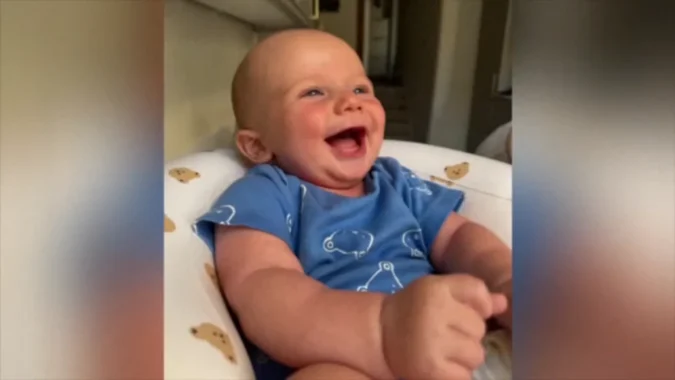
HOUSTON, TX — Doctors at Texas Children’s Hospital say they carried out the first in-utero surgery of its kind in the United States to treat complex gastroschisis, giving one family a path that led to a full-term birth and a healthy baby at home. Theo French was diagnosed during a 20-week ultrasound, when doctors found his intestines were developing outside his body through an opening in the abdominal wall.
His parents, Maisie Savage and Josh French, said they were frightened by the diagnosis and uncertain about what the first months of their son’s life would look like. They later traveled from London to Houston so Theo could be enrolled in the FDA clinical trial. Theo is now 5 months old and, according to his parents and doctors, is doing well.
How the diagnosis changed the family’s plans before birth
Complex gastroschisis can be far more serious than the typical form of the condition. Dr. Sundeep Keswani, associate surgeon-in-chief at Texas Children’s Hospital and principal investigator of the trial, said babies with the condition may face months in the neonatal intensive care unit, repeated surgeries and, in some cases, death.
That reality helped make the offer of a prenatal repair especially meaningful for Theo’s parents. Savage said the family felt “super anxious and scared and worried” as they tried to absorb what the diagnosis meant. Instead of waiting for treatment after delivery, they were told about a possible surgery that could be done before birth, while Theo was still in the womb.
A minimally invasive operation at 26 weeks of pregnancy
Keswani said the operation is usually done around 26 weeks of pregnancy using a minimally invasive approach. Rather than opening the uterus with a large incision, doctors used a tiny keyhole method to reach the fetus, carefully push the intestine back into the abdomen and close the abdominal wall.
The procedure took place at Texas Children’s Hospital as part of a pioneering clinical trial. Theo was the third candidate enrolled, and doctors described the effort as a first step toward treating certain birth defects before delivery instead of after complications begin. The hospital said the approach may help stop disease progression before birth in some cases.
From the womb to full-term birth in just a few months
After the surgery, Theo stayed in the womb so he could continue growing and healing. Doctors said he was then born at full term, at a normal weight, and immediately behaved like a typical newborn. He began breastfeeding soon after birth and was on full feeds by day two.
By day three, he had been discharged from the hospital. Keswani said the quick recovery was a promising sign after such an unusual prenatal procedure. For the family, the result was a far different outcome than the one they feared when they first learned about the diagnosis midway through pregnancy.
Why doctors see the trial as a possible turning point
Texas Children’s Hospital said in-utero surgery at the center has already been used for spina bifida, and some prenatal procedures are also done for heart conditions. This gastroschisis repair adds another condition to the list of problems doctors may someday treat before birth.
Doctors involved in the case said the trial represents a broader push to intervene earlier in fetal medicine. By treating a defect before delivery, they hope to limit later damage and reduce the need for intensive postnatal care. The hospital has presented the procedure as part of a new frontier for fetal surgery rather than a routine option.
Theo’s parents say he is thriving at home at five months old
Now five months old, Theo is at home and doing well, according to Savage and French. They said he is healthy and meeting expectations for a baby his age. French described him as a wonderful little boy who is doing everything a normal baby should do.
The family’s account offers a rare look at how a clinical trial can change the outcome for a child diagnosed before birth. In this case, the surgery appeared to give Theo time to develop safely in the womb and then arrive with far fewer complications than doctors often see with complex gastroschisis.
More on what homes, rents and new builds are doing near you, on RHS Commoner.
