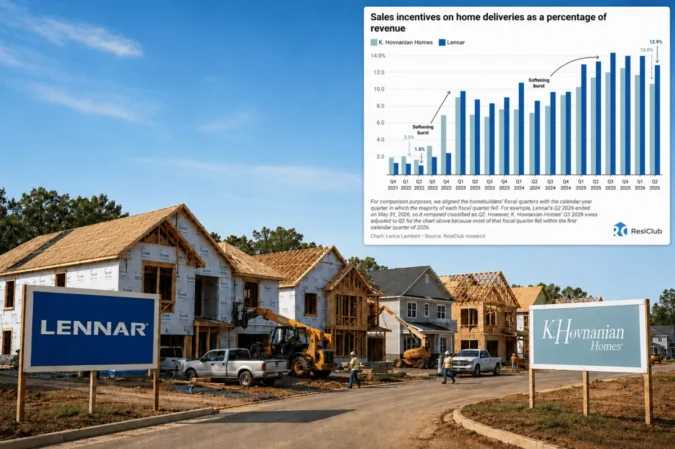
WASHINGTON, DC — Big public homebuilders are still using unusually large incentives to keep sales moving, but the pace of that escalation has started to flatten. In data highlighted by ResiClub, K. Hovnanian Homes reported a 10.8% sales incentives rate for its fiscal third quarter ended July 31, 2026, which works out to about $58,000 per home based on an average selling price of $539,000.
That level is far above the company’s 2022 incentive rate of 2.5% and sits near the elevated levels builders reached after the post-pandemic housing boom cooled. Lennar showed the same pattern: incentives rose from 1.5% in the second quarter of 2022 to 12.9% in the second quarter of 2026, showing how heavily large builders have leaned on discounts and financing help to protect sales.
What The Builder Data Shows
ResiClub said it adjusted K. Hovnanian’s fiscal third quarter to a calendar second-quarter comparison so the numbers line up with other builders. Using that apples-to-apples approach, K. Hovnanian’s incentive rate in the second quarter of 2026 was 10.8%, while Lennar’s was 12.9%. ResiClub also noted that K. Hovnanian’s most recent rate of 10.6% was just under its peak of 12.6% two quarters earlier.
Lennar’s recent 12.6% rate was also below its peak of 14.3% in the third quarter of 2025. The comparison suggests incentives remain historically high even though the fastest run-up may have stopped. Lennar executives have said they view 5% to 6% as a normal baseline, making the current level well above what the company considers ordinary.
Why Incentives Stay High
The bigger backdrop is a housing market that has softened since the demand surge faded in the summer of 2022. Builders responded by offering more help on pricing, closing costs, and mortgage-rate buydowns so monthly payments would remain manageable for buyers. ResiClub said that trend became especially visible in softer parts of the Sun Belt, where cooling has been more pronounced.
Even so, the latest reading points to a plateau rather than a fresh spike. National inventory growth has slowed over the past year, and the number of regional markets with falling home prices has stopped rising as quickly. ResiClub said that means the market is still soft overall, but the burst of softening has eased compared with the earlier part of the cycle.
What Buyers Should Watch
For buyers, renters, and nearby neighborhoods, the key question is whether builders keep paying up to move new homes or are able to trim incentives without hurting sales volume. ResiClub said two things could force incentives higher again: a jump in long-term bond yields that lifts mortgage rates, or a renewed wave of regional housing weakness that shifts more leverage toward buyers.
At the moment, the real-time inventory data does not show a new surge in listings, which suggests the market has not entered another sharp downturn. Readers can track those changes through public builder earnings releases, company investor presentations, and local inventory reports that show how many homes are sitting for sale and how pricing is moving in each market.
More on what homes, rents and new builds are doing near you, on RHS Commoner.
