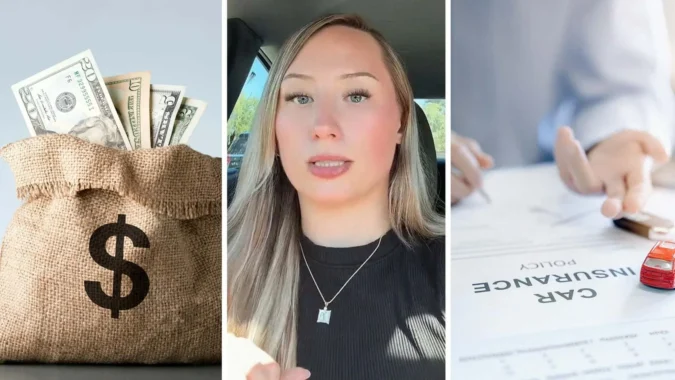
DETROIT, MI — A woman who says she has kept insurance on her car since buying it in 2022 says her credit union quietly added a $150 monthly insurance charge to her auto loan when its records suggested coverage had lapsed.
By the time she noticed the recurring entry, the extra charge had piled up to almost $3,000. The borrower, Rae, says the problem surfaced only after her loan moved onto a new app following a credit union merger, which exposed more detailed payment statements.
She says the monthly payment itself still appeared to go through at $500, but the loan balance was barely falling. After checking the new statements, she says she finally saw a line marked CPI, which led her to the insurance charge tied to the lender’s records.
A merger changed how the loan statements looked
Rae, who says she manages a McDonald’s, posted a video describing how she discovered the charge. In the video, she says she had not been paying close attention to the loan statements and that mistake nearly cost her a large sum.
Before the merger, she says she had already asked the credit union why her principal had not gone down much over time. She says she was told everything looked correct. After the credit union was bought by a larger one, the new app showed a more detailed breakdown that made the monthly insurance add-on easier to spot.
That is when she says she noticed the recurring $150 CPI entry. She looked up the term and learned it referred to collateral protection insurance, a lender-placed policy that can be added when a borrower’s coverage is believed to be missing.
Rae says her car was always insured
Rae says the lender’s assumption was wrong. She says she has had insurance on the car since she got it in 2022 and that the timeline of her one insurer change does not match the date the credit union said coverage disappeared.
She also says the lender had other ways to reach her before adding the charge. In her telling, the credit union said it mailed one notice about insurance, but she says she never received it. She adds that the lender had her phone number and email address.
Her frustration centers on how the issue was handled before the added charge began piling up. In her view, the lender should have used every available contact method before placing insurance on the loan and raising what she owed each month.
What collateral protection insurance usually does
Collateral protection insurance, or CPI, is commonly used when a lender believes required coverage has lapsed on a car loan. The Consumer Financial Protection Bureau has said these policies generally protect only the vehicle itself, not a borrower’s broader liability coverage in a crash.
The CFPB said servicers usually send a notice asking for proof of insurance before buying CPI. But examiners have also found cases where borrowers had valid insurance and were still charged because notices went to the wrong address or proof was not processed correctly.
The bureau has also said that refunding CPI money directly to principal can still leave borrowers feeling shortchanged if they wanted the cash returned to them instead. Rae says that is part of what happened in her case, because the charge was added to the loan balance rather than handled as a direct refund.
Federal actions have flagged similar problems before
The issue is not new. In a 2018 consent order, the CFPB said Wells Fargo had placed insurance on the vehicles of about 2 million auto borrowers since 2005. The bureau said its own analyses found duplicative or unnecessary coverage on hundreds of thousands of those loans.
Roughly 28% of the policies were canceled because the borrower had been insured the entire time, according to the CFPB. The bank and its vendor were required to send written notices and try to call borrowers before buying coverage.
That history is one reason borrower complaints over CPI charges continue to draw attention. The charges can be small enough to miss for months, but over time they can distort a loan balance and make it look as if payments are not working as they should.
The borrower says the credit union is refunding the money
Rae says the credit union is now paying back the roughly $3,000 plus interest to her principal, although she says the money had not yet posted when she shared an email from the credit union on Oct. 8. In that message, the lender said the refund had been verified and was waiting to post to its general ledger account.
She has not named the credit union involved. Her video, which she says was meant as a warning to others, had been viewed more than 18,500 times.
In the comments, some viewers said they had seen similar insurance issues in their own auto loans. Others who said they work in lending argued that CPI is often handled by a third party and that frontline employees may have little control over the process.
Her advice is simple: check the statements
Rae says she is not trying to turn the episode into a blame game. Instead, she says she wants other borrowers to watch their statements closely, especially after mergers or app changes that may alter how loans are displayed.
She pointed viewers toward consumer agencies that handle complaints, including the CFPB for some larger credit unions and the National Credit Union Administration’s Consumer Assistance Center for smaller ones. Her main message, though, was much simpler than the regulatory process.
“Just watch out for anything on your statements,” she wrote. For borrowers whose balances are supposed to be shrinking, she suggests that a line item worth a little attention can become a costly surprise if it sits unnoticed for too long.
More on what homes, rents and new builds are doing near you, on RHS Commoner.
