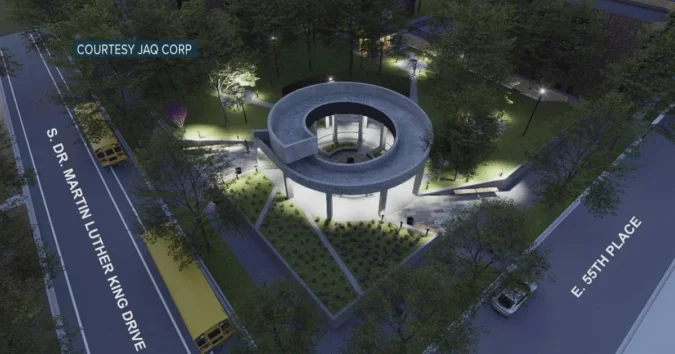
CHICAGO, IL — Construction has finally started on a long-promised memorial in Washington Park for survivors of police torture in Chicago, nearly 11 years after the city approved reparations that included a permanent public tribute. The project is meant to honor more than 125 Black men, women and children who were tortured by former Chicago Police Commander Jon Burge and officers under his command at Area 2 and Area 3 police headquarters.
Survivors and organizers called the groundbreaking a relief and a victory after years of waiting. The memorial is expected to stand as the first state-sponsored monument in the United States to commemorate law enforcement violence, and supporters say it reflects both the pain of the abuse and the long effort to force the city to acknowledge it.
How Chicago’s 2015 reparations package set the memorial in motion
The memorial traces back to the Chicago City Council’s 2015 approval of a reparations package for survivors of police torture. That package did more than acknowledge what happened. It also called for a permanent memorial and later led to the opening of the Chicago Torture Justice Center, which began serving survivors and families in 2017.
Supporters say the memorial has taken far longer than anyone wanted. Joey Mogul, co-founder and president of the Chicago Torture Justice Memorials Foundation, said the work began immediately after the reparations legislation passed, but the process still stretched across multiple city administrations.
Organizers said they met with survivors and family members, gathered input and developed a design, but they did not have consistent support from City Hall for much of the process. They credited Mayor Brandon Johnson’s administration with helping move the project into construction after years of frustration.
Why survivors wanted the memorial on the South Side
Advocates said the location matters as much as the monument itself. Survivors and family members told organizers they wanted the memorial on Chicago’s South Side because that is where many of them lived and where the torture happened inside Area 2 and Area 3 police headquarters.
Joey Mogul said Alderwoman Jeanette Taylor was the only South Side alderperson who allowed the project to move forward in her ward. That support, organizers said, made it possible to place the memorial in the community most directly tied to the abuse and its aftermath.
For survivors, the placement is part of the public acknowledgment they say was missing for decades. The memorial is intended to mark not just a building or a legal victory, but the geography of what happened and the communities that carried the consequences.
A memorial shaped by survivor testimony and decades of organizing
The design, titled Breath, Form, Freedom, grew out of feedback from survivors and their families. The original concept came from Patricia Williams and John Lee, and later work refined the project with help from architect John, who also spoke with survivors, including Stanley Howard.
The memorial includes a spiral shape and pathways that organizers said reflect the experience of being pulled into and trapped by the criminal legal system. It also draws on the pattern of surveillance used in prisons, but turns that idea around to symbolize freedom instead of control.
Organizers said the memorial will include a concrete structure, a timeline of the torture pattern and the long struggle for justice, and words and sayings etched into the ground. They said it is designed to preserve survivor voices that were ignored or dismissed for years.
Anthony Holmes says public memory matters after years of disbelief
Survivor Anthony Holmes said the memorial is important because it gives physical form to what he and others endured. He described the project as a way to express what the state and city did to them and to show that the abuse was real, even after years of not being believed.
Holmes was one of the first survivors to testify during Jon Burge’s trial. He said the new memorial offers hope by making the story visible in public space. For him, the point is not only that people were jailed, but that they were locked up after being tortured into confessions.
Organizers said that kind of acknowledgement remains central to healing. They argued that the memorial gives survivors and their families a place to confront a history that was hidden or minimized for decades.
The torture center and the wider trauma survivors still carry
Aislinn Pulley, executive director of the Chicago Torture Justice Center, said the counseling center has become a crucial part of the city’s reparations response. She said it was the first and only center in the country dedicated to treating survivors of domestic torture.
Pulley said the center has learned from survivors, attorneys and organizers about perseverance through pain. She added that the work has shown how many people carry what she described as invisible trauma after going through the criminal legal system, including family members who fought for loved ones and were ignored for years.
She said the field is still evolving because the harm was not just individual. In her view, the center is helping build a model that connects wellness and healing to the reality of how a society can hurt people and leave them with lasting wounds.
Women survivors and the expected 2027 opening
Organizers also pushed back on the idea that the torture only affected men. They said black women were also tortured and interrogated by Burge and officers under his command at Area 2 and Area 3, even if fewer of those cases were documented because of failures by the Chicago Police Department and the Cook County State’s Attorney’s Office to fully investigate.
That broader history will be part of the memorial’s message, organizers said. They described the project as a record of torture, resistance and the long campaign for justice that followed, including work by survivors, attorneys and independent journalists.
The memorial is expected to open in early 2027. Until then, supporters say the groundbreaking marks a long-delayed but significant step toward permanent recognition of what happened on Chicago’s South Side.
More on what homes, rents and new builds are doing near you, on RHS Commoner.
