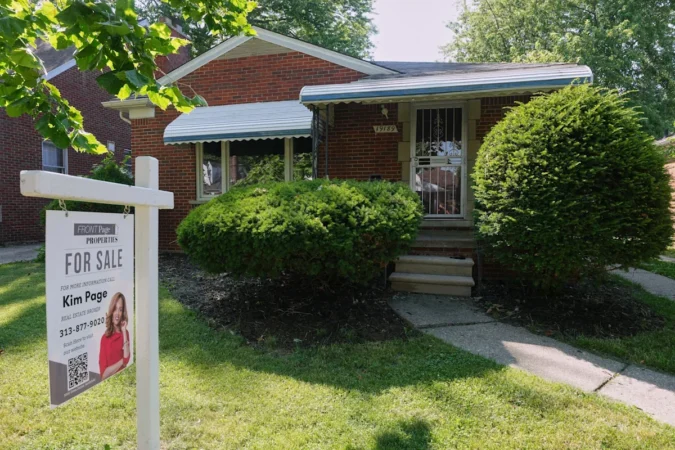
NEW YORK, NY — Mortgage rates stayed pinned near their highest level in almost three years this week, keeping the national market in a high-cost holding pattern for buyers and homeowners looking to refinance. Freddie Mac said the average 30-year fixed mortgage rate reached 7.4% for the week through Wednesday, up from 7.28% a week earlier.
Other major trackers showed similar readings. Mortgage News Daily put the average at 7.59% on Wednesday, while the Mortgage Bankers Association said rates averaged 7.49% for the week through Friday. The persistent move into the mid-7% range has made borrowing more expensive at a time when many households are already weighing higher prices for homes, insurance and taxes.
Bond yields and inflation fears keep pressure on borrowing costs
Lenders have been following bond markets higher as investors worry about government spending and inflation tied to the Iran War and ongoing economic growth. That has pushed mortgage costs up even as some recent bond moves eased slightly from their peak.
This week, the 10-year Treasury yield hovered around 5.3%, after briefly reaching its highest level since 2002. Because mortgage pricing often tracks longer-term bond yields, that backdrop has helped keep home loans expensive. The result is a market where prospective buyers may qualify for less house than they would have only a few years ago, while current owners are less likely to find a refinance that makes sense.
Realtor.com says the housing market is already feeling the strain
Higher rates are not just a finance-market story; they are showing up in housing activity. Joel Berner, a senior economist at Realtor.com, said the elevated rate environment has “spooked” the market.
Berner said pending home sales fell year over year in both August and September, even before rates moved above 7%. He also said sellers have been forced to cut prices at a pace not seen in four years. Those signs suggest the rate surge is not only affecting affordability, but also slowing the pace at which homes are moving through the market.
For buyers, that can mean fewer affordable monthly payment options. For sellers, it can mean longer listing times and more pressure to meet the market where it is now, not where it was during the low-rate period.
Zillow’s national rate snapshot shows purchase loans still in the mid-7s
Zillow’s Thursday, Oct. 8, 2026, national averages show how broad the pressure remains across common loan products. For purchase mortgages, the 30-year fixed rate stood at 7.52%, while the 20-year fixed was 7.36% and the 15-year fixed was 6.70%.
Adjustable-rate loans were not dramatically cheaper. The 5/1 ARM averaged 7.13% and the 7/1 ARM came in at 6.98%. Among VA purchase loans, the 30-year averaged 7.10%, the 15-year averaged 6.58%, and the 5/1 VA averaged 6.16%. These are national averages rounded to the nearest hundredth, so actual offers can vary by lender and borrower profile.
Refinance rates are also elevated despite some lower VA pricing
Refinancing has not offered much relief either. Zillow’s national refinance averages for Thursday showed a 30-year fixed rate of 7.41% and a 20-year fixed rate of 7.41%. The 15-year refinance rate averaged 6.76%, while the 5/1 ARM stood at 7.39%.
VA refinance rates were somewhat lower in several categories, with the 30-year VA at 6.91%, the 15-year VA at 6.81% and the 5/1 VA at 6.28%. Even so, refinancing is still a higher-cost decision for many households than it was during the era of ultra-low rates. In general, refinance pricing can be slightly higher than purchase pricing, though that is not always the case.
What borrowers can do while rates stay elevated
The national average does not tell every borrower the same story. Lenders consider credit score, debt-to-income ratio, down payment and overall financial profile when setting an offer. Buyers who can improve those factors before applying may be able to secure a better rate and lower fees.
The article also notes that shopping around matters. Borrowers can compare offers from banks, credit unions and mortgage specialists, and they can use payment calculators to see how rate changes affect monthly costs. Those calculations should include principal, interest, private mortgage insurance if required and HOA dues when they apply. For many families, the difference between a 15-year and 30-year loan is not just the rate itself, but whether the monthly payment fits the budget.
How the current rates compare with past lows
The present market looks especially high when compared with the recent past. Freddie Mac says the lowest-ever national average on a 30-year fixed mortgage was 2.65% in January 2021. The story also notes that a 2.75% rate is exceptionally rare in today’s market unless a buyer is able to assume an older mortgage from a seller who locked in a low rate in 2020 or 2021.
That gap helps explain why the current environment feels so different for shoppers and homeowners. A 30-year loan can still be popular because it keeps monthly payments lower, but that structure also means paying interest over a much longer period. A 15-year mortgage typically carries a lower rate and builds equity faster, but the monthly payment is higher because the balance is repaid in half the time.
More on what homes, rents and new builds are doing near you, on RHS Commoner.
