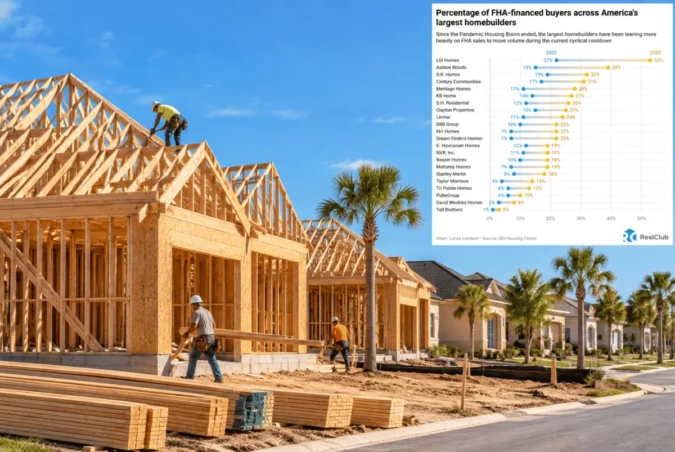
WASHINGTON, DC — FHA loans are accounting for a larger share of sales at major homebuilders as affordability remains strained after the Pandemic Housing Boom faded. ResiClub says the shift has continued since mid-2022, when home prices and mortgage rates moved buyers out of the easy-money conditions that fueled the boom.
The change matters because FHA financing is most common among first-time buyers and households with thinner credit or smaller down payments. That makes the FHA share of a builder’s sales a useful signal for how dependent that builder is on the lower end of the for-sale market. In many cases, builders are now reaching more deeply into that buyer pool just to keep sales moving.
Why FHA financing has become more important for builders
FHA mortgages, which are insured by the Federal Housing Administration, can require as little as 3.5% down and allow lower credit scores and higher debt-to-income ratios than most conventional loans. For buyers who cannot qualify for a standard loan at a payment they can afford, FHA can be the difference between buying and staying out of the market.
ResiClub notes that the post-boom increase is partly a return to normal after the frenzy of 2020 through mid-2022. During that period, conventional financing was cheap, demand was far stronger than supply, and builders did not need to rely as much on FHA borrowers. As the market cooled, that mix changed.
Rate buydowns and in-house lenders help close more deals
Big builders have also adapted by leaning on their own mortgage operations and by offering rate buydowns. Those tactics became more important after the 2022 rate shock, when buyers suddenly faced much higher monthly payments and needed help to qualify. D.R. Horton, one of the largest builders, is cited as an example of a company that routes most of its buyers through its own mortgage arm.
FHA can be especially useful in that setup because sellers may contribute up to 6% of the purchase price toward a buyer’s costs, compared with 3% on conventional loans with less than 10% down. FHA also does not penalize lower credit scores the same way conventional pricing often does, and the annual mortgage insurance premium was cut by HUD in 2023 from 0.85% to 0.55%.
The buyer mix varies sharply from builder to builder
ResiClub and the AEI Housing Center found a wide gap in FHA usage among large builders. In 2025, about 3% of Toll Brothers buyers used FHA financing, while 53% of LGI Homes buyers did. That spread lines up with their price points: Toll Brothers’ average selling price is $996,400, while LGI Homes’ average is $367,407.
The numbers do not mean that builders with higher FHA exposure are automatically in trouble. They do show that some companies are much more tied to the health of FHA borrowers than others. That leaves them more exposed if stress builds at the bottom of the market.
Delinquency trends show more strain among FHA borrowers
Overall mortgage delinquencies remain relatively low by historical standards, helped by a tighter credit box than the one that existed in the mid-2000s and by homeowners’ sizable equity cushions. The labor market has also held up, even if it is softer than it was several years ago. But FHA loans have shown more stress than other loan types in recent years.
30-plus-day delinquency transition rates on FHA loans have risen meaningfully since 2022, while GSE loans backed by Fannie Mae and Freddie Mac have stayed more subdued. VA loans have also moved higher, but FHA stands out in the data. That pattern fits the profile of FHA borrowers, who tend to have lower credit scores and thinner financial buffers.
The South’s heavy FHA use makes regional exposure more important
FHA is still a minority slice of the national mortgage market. The New York Fed says FHA mortgages made up about 12% of the nation’s $12.94 trillion in mortgage debt in 2025. But the program is not evenly distributed across the country, and the concentration matters for builders.
The U.S. South, where much of the nation’s single-family homebuilding is concentrated, has a higher share of FHA mortgages than many parts of the Northeast and West Coast. States including Mississippi, Louisiana, Alabama, and Texas stand out. Because many large production builders are also concentrated in the Southeast and Texas, any further stress among FHA borrowers could show up first in those markets.
Federal policy changes also cut into FHA demand in 2025
FHA demand took another hit in March 2025, when the Federal Housing Administration said H-1B visa holders and other non-permanent residents would no longer be allowed to take out new FHA mortgages starting in late May. Optimal Blue data showed the effect quickly in mortgage lock activity.
According to that data, non-permanent residents’ share of FHA mortgage locks fell from 3.8% in September 2024 to 0.2% in September 2025. ResiClub says it has not seen a comparable shift in the conventional GSE market. Taken together, the changes reinforce the same point: FHA has become a more important channel for homebuilders, but it is also the part of the market showing the clearest signs of strain.
More on what homes, rents and new builds are doing near you, on RHS Commoner.
