SOUTHAMPTON, NY — Southampton could soon sharply expand its down payment assistance program, giving would-be buyers a bigger path into homeownership and offering a new incentive for local first responders to stay in the town’s emergency services.
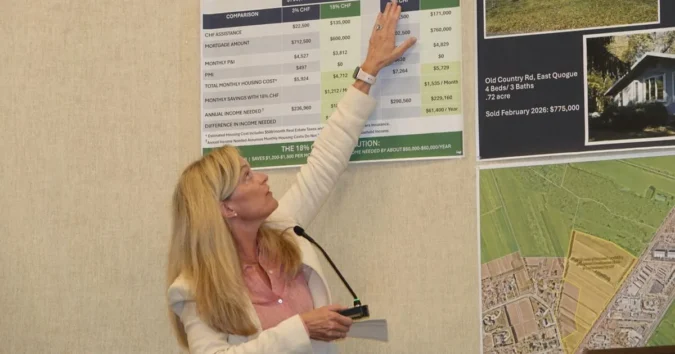
Housing and Community Development Director Kara Bak told the Town Board that raising assistance from 3 percent of a home’s sale price to 18 percent would reduce the amount buyers need to bring to closing and ease the income required to qualify for a mortgage. She said the change could also eliminate private mortgage insurance in many cases, lowering monthly housing costs.
Bak described the proposal as a way to make existing homes more attainable without waiting for new construction or land deals. The board signaled strong support, and Bak said she will bring a formal resolution back for consideration at the next meeting on September 24.
Town officials say the math changes quickly at local home prices
Bak presented examples showing how much more affordable a home can become if the town boosts assistance. On a house priced around $750,000, she said the current program leaves a buyer with a monthly mortgage payment of about $5,900 and an annual household income requirement of $236,000.
Under an 18 percent loan, that monthly payment would fall to roughly $4,700 and the income needed would drop to $188,000. Bak said that is a reduction of $48,000 in annual income just to make the purchase work.
She said the same pattern appears at higher price points. For a $950,000 home, the required income would fall from about $290,000 to $229,000, while the monthly payment would drop from more than $7,200 to about $5,900. In both cases, the higher assistance level could be the difference between qualifying and being shut out.
Loan forgiveness would reward years of service in emergency response
The proposal also includes a separate benefit for local first responders. Bak said emergency service workers who buy homes through the program would have their down payment loans forgiven over 10 years, with the balance reduced by 10 percent each year after closing.
She estimated that equals roughly $10,000 to $15,000 a year in forgiven debt, depending on the size of the loan. The application process would stay the same, but the service-based payback structure would create a direct link between housing help and town priorities.
Bak said the goal is both to help people remain in Southampton and to make sure the people who respond to emergencies can continue to live in the community they serve. Town officials framed the change as a way to strengthen recruitment and retention for volunteer fire and ambulance services.
The town has used the housing fund sparingly so far
Southampton added down payment assistance to its Community Housing Fund in 2024, setting aside $1.25 million in zero-interest loans. The program was widely seen as a promising way to support middle-income residents and workers who earn too much for traditional affordable housing but still cannot buy locally.
Yet in nearly two years, only three loans have been awarded. Bak said one reason is the challenge of coming up with a large upfront payment even when a home seems close to affordable on paper.
She said many buyers can handle a monthly payment but cannot bridge the gap when the down payment requirement is more than $100,000. The town’s lending model is designed to relieve that barrier, but the low take-up suggests the current terms have not been strong enough to move enough buyers from renting to owning.
Funding from the transfer tax has left room to expand
The Community Housing Fund is financed by a 0.5 percent transfer tax on most real estate transactions, a measure that has brought in about $55 million since taking effect in 2023. According to Bak, the town has spent or committed only about half that amount so far.
That leaves about $28 million available immediately, giving the board flexibility to expand the program and add more money to it. Bak asked officials to allocate another $4 million to down payment assistance, saying she expects demand to rise if the town makes the terms more generous.
Unlike the larger share of the fund devoted to land purchases and subsidies for new projects, this program uses the existing housing stock. Bak said it does not require new approvals, more density, or construction timelines, which makes it a faster tool for addressing affordability.
Housing advocates and board members backed the proposal
Joy Cianci, a longtime housing finance executive and member of the town’s Community Housing Fund Advisory Committee, said saving for a down payment remains the biggest obstacle for many people trying to buy a home. She said student debt and high rents leave even well-paid residents without enough cash saved to get started.
Gwen O’Shea, president of Community Development Long Island, which administers the loan program, said the nonprofit also provides education and counseling to help buyers prepare. She said prospective homeowners need guidance on rates, lending options, and debt-to-income ratios so they can enter ownership in a stable financial position.
Board members responded enthusiastically. Councilwoman Cyndi McNamara said she likely would not own a home without down payment assistance, while Councilman Michael Iasilli said forgiveness for first responders should help draw more volunteers. Jimmy Mack of the Southampton Volunteer Ambulance warned that younger responders keep leaving and said the town’s service ranks are increasingly older.
More on what homes, rents and new builds are doing near you, on RHS Commoner.
