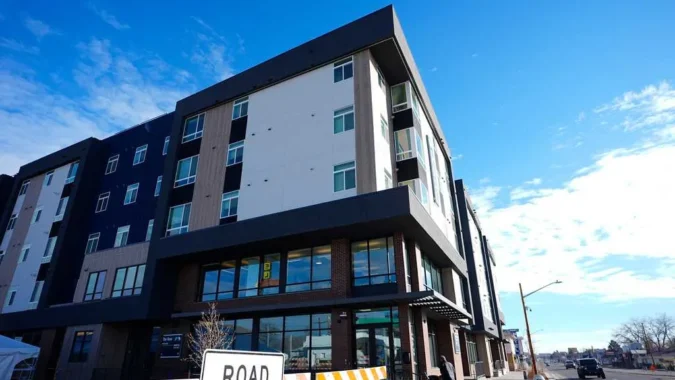
AUSTIN, TX — People with the lowest incomes are finding it hardest to secure housing even as thousands of apartments labeled affordable remain vacant in Austin and other U.S. cities. For Mathew Davis, who lives in a homeless shelter and earns only a few hundred dollars a month donating plasma, even a modest tiny home would be out of reach.
That mismatch reflects a larger national problem. Housing built with federal tax credits and other subsidies is often priced for households earning 50% or 60% of area median income, while renters at 30% of median income or below are left with far fewer options. The result is a market where some apartments sit empty because the poorest families cannot pay the rent.
Why the lowest-income renters face the tightest squeeze
About 11 million renter households in the United States are considered extremely low-income, but only about 4 million affordable rental units are available to them, according to the National Low Income Housing Coalition. That gap leaves many households competing for too few homes and often paying far more than they can comfortably afford.
The coalition says roughly three-quarters of extremely low-income renter households spend more than half of their income on rent and utilities. Many are people in low-wage jobs, seniors living on fixed incomes, or renters with disabilities. The federal poverty guideline for a single-person household is just under $16,000 a year, though the official extremely low-income threshold can also be based on 30% of local median income.
Tax-credit housing reaches higher incomes more often than the poorest tenants
The Low-Income Housing Tax Credit is the main federal program used to finance affordable apartments, and it has helped create nearly 4 million units nationwide over the past 40 years. But state housing agency data show that only about 12% of the units financed in 2024 were set aside for renters at or below 30% of area median income.
Most of the units are instead aimed at households earning at least 50% of area median income. In Austin, that can mean a single renter making about $47,000 a year, compared with an extremely low-income renter making under $28,000. Some developers and policy experts say that gap makes it hard for the poorest residents to benefit from the subsidy structure.
Developers say the numbers do not work without more subsidy or vouchers
Affordable housing developers say the economics often break down when projects are designed for the poorest renters. Carmen Romero, president and CEO of True Ground Housing Partners in the Washington area, said a unit priced for someone earning 60% of area median income can leave only a small margin after mortgage and operating costs are paid.
Romero said the problem becomes even harder at 30% of area median income, where rents would be far lower. Chris Edwards of the Cato Institute argues the tax-credit system is overly complex and costly, and he favors vouchers that go directly to tenants. Supporters of the current model say tax-credit properties often accept vouchers, while many market-rate landlords do not.
Vacancies are rising where affordable rents are too close to market rates
In several cities, rents for units labeled affordable have moved close to the cost of market-rate apartments, giving renters more reason to skip the added paperwork and wait for a quicker approval elsewhere. That is one reason vacancies are climbing in parts of Austin, Denver and Portland.
CoStar data show Austin’s overall vacancy rate for affordable housing is nearly 16%, with more than 4,500 empty units. LDG Development said its 60% area median income properties there had a 12% vacancy rate. In Denver, the Colorado Housing and Finance Authority reported vacancies of 13% in 60% AMI units and 21% in 80% AMI units financed by the tax credit program.
Portland and Austin show how fast the middle of the market can crowd out the poorest
Portland’s housing bureau said there were more than 1,700 vacant affordable units in the city, for an overall vacancy rate of 7.5%. Most of those apartments are aimed at households earning 60% of area median income, or about $54,000 for a single person, with rent capped at $1,444 a month.
That is close to the average $1,581 rent for a one-bedroom market-rate apartment cited by CoStar. In Austin, LDG chief portfolio officer Rebekah Fischer said affordable projects compete directly with thousands of new market-rate apartments, where applicants can often be approved far faster and with less documentation.
Austin has built far fewer deeply affordable homes than planned
Austin officials set a goal of producing 20,000 units for extremely low-income households between 2018 and 2027. City documents show that only 543 had been built by 2024, while all 15,000 planned units for households earning between 60% and 80% of area median income were completed.
The city housing department said it recognizes the need to do more for the poorest residents and has started giving preference to funding proposals that include 30% AMI units. For Davis, who spent a year living in his car before getting a bed in a shelter, the shortage is personal. He says he wants a place where he can simply close the door and sleep.
More on what homes, rents and new builds are doing near you, on RHS Commoner.
