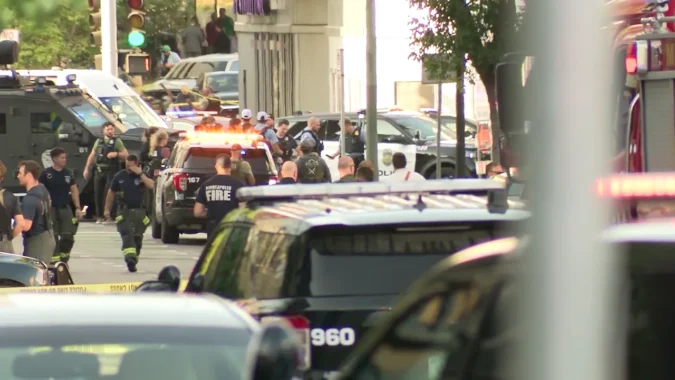
MINNEAPOLIS, MN — The shooting that killed three people and injured six others in downtown Minneapolis is forcing a closer look at two Minnesota gun-related rules: the state’s red flag law and the limits on what landlords can do about firearms in rental housing.
5 EYEWITNESS NEWS says it found multiple incidents in recent months in which Carlton Johnson II disturbed residents at Shoreline Plaza, raising questions about why he remained there and why he was still armed. The shooting happened Wednesday night and has quickly become part of a broader debate over whether existing safeguards were used, or could have been used, before the violence.
Minnesota’s red flag law allows judges to temporarily block gun access when someone is a danger
Under Minnesota’s extreme risk protection order law, often called the red flag law, a judge can temporarily stop someone from possessing or buying firearms if that person is found to pose a significant danger. The state confirmed to 5 EYEWITNESS NEWS that no ERPO was issued for Johnson.
There was, however, at least one earlier attempt to weigh the law. In June, Minneapolis police responded to an incident involving Johnson displaying a firearm at another person. Hennepin County Attorney officials later declined charges and determined there was insufficient evidence to move ahead with an ERPO petition.
The law took effect in 2024, and its use has grown quickly. Densley said 138 ERPOs were issued in 2024, rising to 314 in 2025. Through July of this year, 240 had been issued.
Only certain people can file an ERPO, and the paperwork must show danger
Not everyone can ask a court for a red flag order. Minnesota law limits ERPO petitions to family members, law enforcement, and city or county attorneys. Those filing must document why the person is a significant danger to themselves or others.
Warning signs can include threats, brandishing firearms, and stalking. James Densley, a criminal justice professor at Metro State University, said an approved order could have changed the outcome in this case. He said that if an ERPO had been in place, lives might have been saved and the tragedy could have been reduced.
5 EYEWITNESS NEWS said it asked the Hennepin County Attorney for more detail about the decision and the finding of insufficient evidence, but had not received a response.
Rental housing leaders say landlords need more room to screen risky tenants
The shooting has also renewed attention on Minnesota’s landlord gun rules. The state is one of a small number that do not allow landlords to ban tenants from having guns in their homes.
Cecil Smith, president and CEO of the Minnesota Multi-Housing Association, said he does not object to that rule on its face. But he said landlords should have more ability to tighten screening when public safety is at stake. He pointed to limits on the criminal history and eviction information available to housing providers.
Smith said better information could lead to better decisions when a tenant starts to become threatening. He argued that some violence might be avoided if landlords knew more about past behavior.
The downtown shooting follows another deadly housing dispute in St. Paul
The Minneapolis case is landing in a state already wrestling with another high-profile apartment killing. Earlier this summer, a shooting in St. Paul left three people dead after a tenant dispute with management. Smith said that case, along with Wednesday’s attack, is adding urgency to the discussion inside the rental housing industry.
That broader context is why landlords are pushing for more screening tools, even as critics warn that broader access to tenant data could make it harder for people to find housing. The tension is between preventing violence and keeping rental access open to more people.
For now, the debate is centered on what landlords can know, what police and prosecutors can act on, and whether the existing system gave officials enough opportunity to intervene before the Minneapolis shooting.
Questions remain about what officials knew before the shooting
The case has become a test of how separate systems overlap when warning signs appear. Police had one documented encounter involving a firearm, prosecutors reviewed whether an ERPO should be sought, and the state says no order was ever issued.
At the same time, housing advocates and industry leaders are revisiting what landlords can and cannot do when a resident appears volatile. The current law leaves them unable to prohibit guns outright, while also limiting the information they can use during screening.
As investigators continue to sort out the Minneapolis shooting itself, the policy debate around it is only growing. For lawmakers, prosecutors, police and landlords, the central question is whether any of the existing tools could have been used more effectively before the violence that left three people dead and six injured.
More on what homes, rents and new builds are doing near you, on RHS Commoner.
