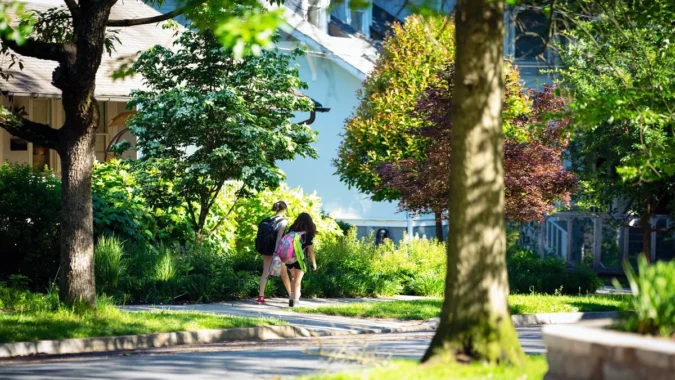
NEW YORK, NY — Parents looking for a house are not just counting bedrooms anymore. A new National Association of Realtors survey found that 63% of people would pay more for a home in an area where they can easily walk to parks, shops and restaurants, while 59% would pick a smaller lot in a walkable neighborhood over a larger one that required more driving.
The Realtor.com analysis behind the piece says the appeal goes further when school access is part of the package. Families often weigh safety, school quality and neighborhood design together, and for many of them, a short walk to class can be worth a higher asking price if it also cuts down on daily driving and drop-off routines.
What The Numbers Show
The analysis says highly rated school districts carried a median list price of $1.21 million, which was 135% higher than surrounding metro areas. That gap reflects the premium some buyers assign to location, school reputation and the ability to move around a neighborhood on foot.
Several real estate professionals quoted in the piece say the trade-off is common in expensive markets and planned communities. Michelle Griffith, a luxury broker with Douglas Elliman in New York City, said families often give up space and finishes if the location lets children walk to school safely. Stephen Poulakos, director of town planning and design at Seabrook in Pacific Beach, Washington, pointed to Trilith in Fayetteville, Georgia, as one example of a place where walkability is part of the value.
In Realtor.com listings cited in the piece, a three-bedroom, 1,864-square-foot townhome in Trilith was listed at $749,950, or $402 a square foot. A similar property elsewhere in Fayetteville was listed at $359,900, or $225 a square foot.
Why Families Pay Up
The appeal is mostly practical. Griffith said living close enough to school can mean less time spent in traffic, fewer bus or subway delays, simpler pickup and drop-off, and more independence for children as they get older. Poulakos added that buyers are often purchasing more than a single house; they are choosing a neighborhood layout with parks, public spaces and infrastructure that supports daily life.
The article also links walkability to the way communities are built. Poulakos said the strongest walkable areas tend to mix housing types on the same block, including accessory dwelling units, single-family homes, duplexes and other multifamily buildings. He said that kind of density can increase foot traffic, make streets feel safer and support nearby retail that can be reached without a car.
Griffith said families are increasingly asking what a child can safely do from a location, not just how much space a house has. In her view, that shift helps explain why a smaller home in a more usable neighborhood can compete with a larger home that sits farther from school and other daily destinations.
How Buyers Can Check
For parents comparing homes, the article recommends walking the neighborhood more than once and at different times of day. Poulakos said 8 a.m., 6 p.m. and 10 p.m. are especially useful because they show the school commute, evening activity and nighttime conditions. A route that looks quiet on a Saturday afternoon may feel very different during the school rush or after dark.
Griffith advised looking for a continuous sidewalk network, safe crossings, visible crosswalks and crossing guards where needed. She also said buyers should pay attention to vehicle speed, not just traffic volume, and look for traffic-calming features such as speed humps, raised crossings or curb extensions. Sight lines matter too, including whether parked cars or landscaping block a driver’s view of children near a crossing.
She also suggested talking with nearby parents about the best walking routes and how the area feels at different times of year. That can help families judge whether the walk to school is truly manageable before they make an offer.
More on what homes, rents and new builds are doing near you, on RHS Commoner.
